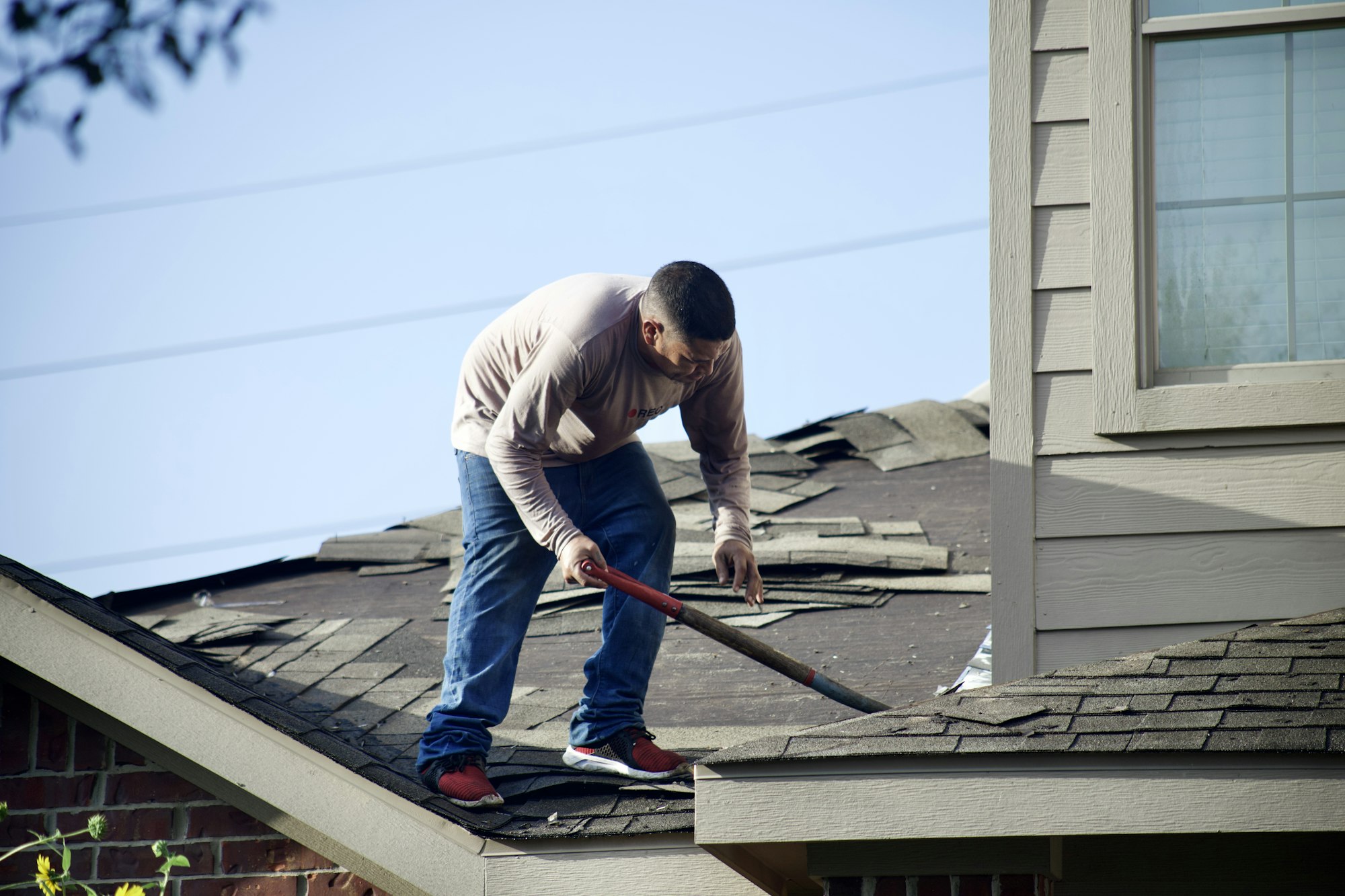
The question comes up on almost every quote in Grayson County, usually phrased as a hope rather than a question: can we just go over the old ones? It is a reasonable thing to ask. A tear-off is the loud, dusty, expensive part of a roof replacement, and skipping it looks like free money.
Sometimes it genuinely is allowed. More often, on a Sherman house built in the last thirty years, it is not, and the reasons have less to do with rules than with what you stop being able to see. Here is how the decision actually gets made before anyone quotes a price.
A Recover Is a Different Job From a Replacement
The two words get used interchangeably by homeowners and never by roofers. The Asphalt Roofing Manufacturers Association defines replacement as the process of removing the existing roof covering, repairing any damaged substrate, and installing a new roof covering. A recover is the process of installing an additional roof covering on an existing roof covering. One ends with a roof you have inspected. The other ends with a roof you have covered.
ARMA is not against recovering, and that is worth saying plainly, because roofers are sometimes accused of inventing the tear-off to pad an invoice. The association's own position is that in many cases it is not necessary to tear off old shingles before installing new shingles, and that if a roof has only one layer of shingles that lies flat and the deck is in good condition, replacement may not be necessary. The conditions in that sentence are doing all the work.
The Code Sets a Ceiling, Not a Recommendation
Every Texas city that has adopted the International Residential Code works from the same baseline: all existing layers of roof coverings must be removed down to the sheathing before reroofing, with a short list of exceptions. One of those exceptions permits a single recover, and the limit is hard. The City of Arlington's residential re-roof bulletin, working from the 2021 code, states the final inspection check in one line: verify that no more than one existing layer of asphalt or composition shingles has been covered over.
So a house that has already been recovered once has no second chance. Everything comes off. The same bulletin also bars a recover where the existing roof covering is water-soaked or has deteriorated, which quietly rules out a great many of the roofs people most want to cover. Sherman sits under the city's building authority or the county's, depending on where your house is, and the number of permitted layers is the kind of thing a local inspector checks at final rather than takes on trust.
- The existing roof already has two or more layers of covering
- The existing shingles are water-soaked or deteriorated
- The existing surface is too uneven or distorted to flatten
- The deck underneath is suspected of rot, warping or wide gaps
- The existing shingles are laminated, in most manufacturers' view
The Deck Is the Part You Give Up Looking At
This is the real argument, and it has nothing to do with permits. A tear-off is the only moment in a roof's life when somebody sees the wood. ARMA's guidance is that rotted or warped boards, or gaps greater than a quarter inch, have to be dealt with before reroofing, and that replacement offers the opportunity to inspect the roof deck and repair any damage. The Texas Department of Insurance puts the homeowner's side of it more bluntly still: you should have your roof deck inspected.
On a Sherman roof that has been through twenty summers of attic heat and a decade of small spring hail, the deck is not usually ruined. It is usually fine in most places and soft in two or three, around a chimney, at a valley, under a vent boot that failed quietly three years ago. Those are exactly the spots a recover seals up and forgets. The shingles above them will look perfect for years while the wood underneath keeps going.
Laminated Shingles Changed the Arithmetic
Most of what went on North Texas roofs in the last two decades is architectural, or laminated, shingle. ARMA notes that most manufacturers do not recommend installing new shingles over existing laminated shingles, and the reason is physical rather than legal. A laminated shingle is built in two bonded layers, so its surface is deliberately uneven. Lay flat new shingles across that and every ridge telegraphs through, which is both a cosmetic problem and a sealing problem.
The association's wider test is whether existing shingles are so uneven and distorted that it would not be either possible or practical to flatten all raised areas. On a curled, heat-aged Texas roof, the honest answer is usually no. That is why the recover question tends to answer itself on houses from the 2000s onward, and why it is still occasionally a live option on an older three-tab roof that has stayed flat.
A Second Layer Costs You Things You Cannot See
Weight is the first. ARMA's instruction is to make sure the structure beneath the roof deck has sufficient capacity to bear the weight of another layer of shingles, which on a wide-span Texas truss roof is a question worth asking rather than assuming. Fastener grip is the second: the same guidance asks that the deck remain structurally sound and allow for adequate fastener retention, and nails driven through two layers of shingle have less wood to hold onto, which matters on a roof that meets straight-line winds most springs.
Then there is the one most homeowners never hear until it is too late to matter. ARMA states that impact resistance ratings for asphalt shingles may be affected when new shingles are installed over existing shingles. If the shingles you are buying carry an impact rating, and you are counting on it, covering rather than replacing can undercut the thing you paid extra for. Finally, the next roof pays for this one: a two-layer tear-off is materially more work than a one-layer tear-off, and that cost lands on whoever owns the house in fifteen years.
Underlayment Is the Other Thing a Recover Skips
Beneath the shingles there is a sheet doing quiet work. ARMA's underlayment bulletin describes it as a secondary layer of protection beneath the shingles, notes that shingles should not be installed directly on a wood deck substrate, and points out that underlayment is a required component in a fire-classified roof assembly. Arlington's bulletin is blunter about re-roofs: underlayment must also be replaced when re-shingling a roof.
A recover leaves the original underlayment in place, now twenty years old, under a layer of old shingles, under a layer of new ones. It is still technically there. Whether it is still doing anything is not a question anyone can answer without pulling the roof apart, which is the thing a recover exists to avoid. A full roof replacement in Sherman resets that layer along with everything else.
How to Settle It on Your Own Roof
Three facts decide it, and you can gather two of them yourself. Count the layers at a cut edge or a rake, because a house that has already been covered once is settled. Look at the shingle profile: flat three-tab keeps the option open, laminated almost always closes it. The third is the deck, and that one needs somebody on the roof and in the attic with a light. If a recover survives all three tests it is a legitimate choice and a cheaper one. If it fails any of them, a recover is not a saving, it is a deferral with interest.
If you are weighing the two on a house anywhere between Denison and Van Alstyne, a free roof inspection will tell you which of those three facts actually applies to your roof, with photographs of the deck rather than an opinion about it.